Trump Raises Tariffs on Chinese Goods to 104%? Beijing's Standoff Draws Public Attention
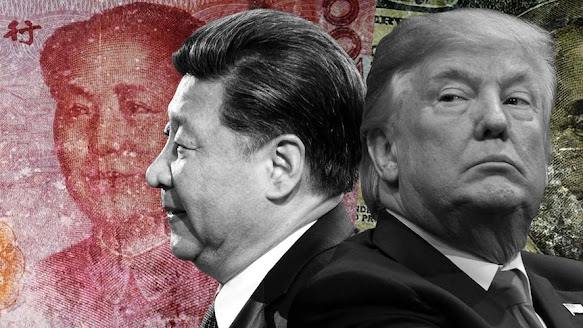
On April 7, 2025, US President Donald Trump announced from the Oval Office of the White House in Washington, DC, that the US would again raise import tariffs on Chinese products by 50%. Combined with previous tariffs, the total US tariffs on Chinese products would reach 104%. The public is now watching how the Chinese Communist government will respond and how this tension will end.

Trump, who is currently serving his second term, has increasingly shown a tough stance against the Chinese Communist Party (CCP) through his trade war policy. After the US government raised tariffs by 20% on Chinese goods in February and March, on April 2, the government announced a “reciprocal tariff” strategy with an additional increase of 34% scheduled to take effect on April 9.
.png)
Photo : "It's Time To Rock'N Roll, Mister Chinese Food!"
While many countries expressed their readiness to negotiate with the US to reduce tariffs together, on April 4 the Chinese government announced a retaliatory measure, namely imposing a 34% tariff on imported products from the United States, scheduled to take effect on April 10.
In response, President Trump strongly condemned the CCP's actions and said he would take even more severe punitive measures.

On April 7 (Eastern US time), Trump announced via his social media, Truth Social, that "If China does not lift the additional 34% tariffs imposed on top of their long-standing trade abuses by April 8, the US will impose an additional 50% tariff starting April 9."
Trump also warned that if China does not back down, “China’s demand for talks will be completely canceled!”
If the new tariffs are imposed, the total US tariffs on China will reach 104%.
Trump’s increasing assertiveness towards China raises a big question: how will Beijing respond, and what kind of impasse will it face going forward?
On April 8, senior US journalist Fang Wei wrote on the X platform: “What will the CCP do now? Lift the tariffs? And what about their face? In the eyes of the CCP, face equals the legitimacy of power, and it can shake the stability of the regime. If it is not lifted, China’s foreign trade with the US could be paralyzed, and its economy could plunge into negative growth overnight — which also threatens the regime. This is what is called: ‘Advance is hit, retreat is hit.’”
.jpg)

.jpg)
That same day, Fang Wei created a poll on the X platform: “Will the CCP lift its 34% tariffs on the US on April 8? As of 11:00 a.m. Beijing time, 82.9% of respondents voted ‘No, they will go all out.’”
Prof. Xie Tian from the Aiken School of Business, University of South Carolina, told the Epoch Times that this trade war was deliberately aimed at the CCP with the aim of eliminating China’s huge trade surplus with the US. However, the CCP could not accept the US’s demands because it did not want to lose the surplus.

Xie explained that the CCP already knew that it could not escape, and all loopholes for tax avoidance had been closed. They were also aware that the US’s ultimate goal was to eliminate the surplus and destroy the CCP’s economic power. But because they had no cards to play, they could only surrender but still felt unacceptable — and finally chose the “free fall” strategy.
Meanwhile, China’s tech industry policy analyst and former Wall Street Journal Mandarin columnist Dong Jielin said on the X platform that “The global trade war triggered by the US has now turned into a trade war between the US and China.” Regarding the impact on the Chinese side,
Dong outlined the following points:
* China’s trillion-dollar trade surplus, both directly and indirectly, is mostly with the US — and it will most likely disappear.
* China’s industrial capacity will have to be halved; the overcapacity bubble could burst, and the impact would be as severe as the property bubble burst.

SCAN ME FOR YOUR SEX
SCAN ME FOR YOUR SEX* Unemployment will skyrocket, threatening social stability.
* The international systems that China has built in recent years, such as the “Belt and Road,” “BRICS,” and “SCO,” are mostly filled with countries that want to profit from China. When those profits are gone, they will simply dissolve. (jhn/yn)